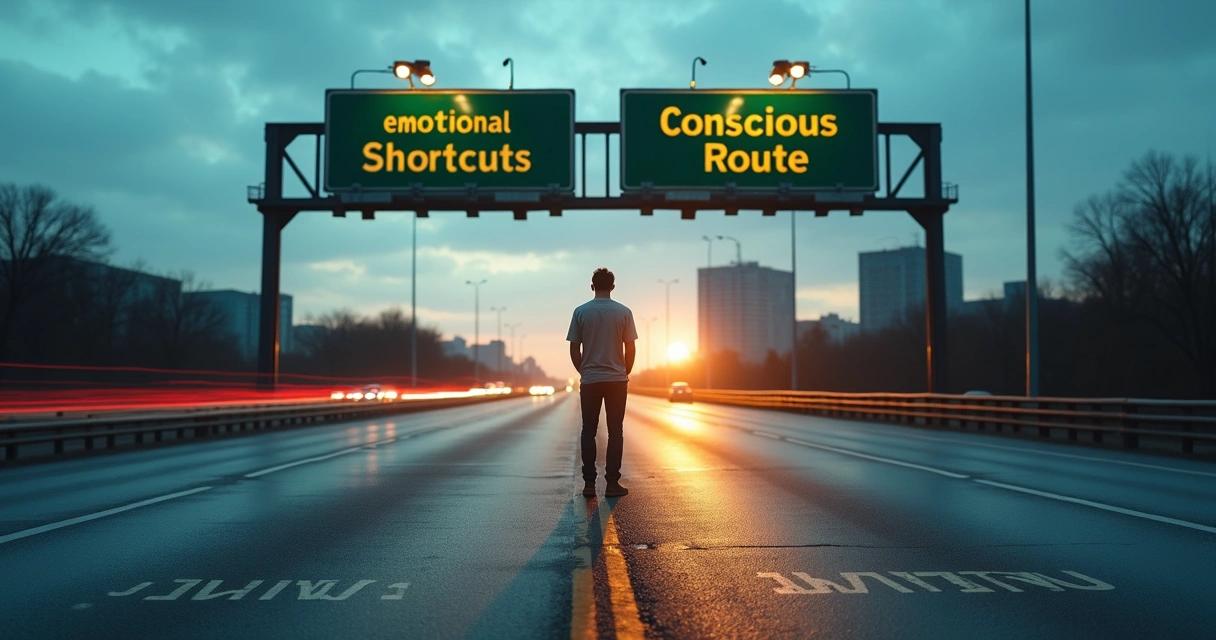
We all do it. A message comes in with a sharp tone, and we assume rejection. A delay happens, and we call it failure. Someone disagrees, and we feel attacked. These are emotional shortcuts. They are fast inner jumps that turn a feeling into a conclusion before thought has time to breathe.
Emotional shortcuts are quick reactions that replace clear perception with old patterns.
In our experience, these shortcuts do not begin in the moment itself. They begin earlier, in habits of interpretation. We carry unfinished fear, old shame, hidden anger, and silent urgency. Then life touches one point, and the whole inner structure reacts at once.
Fast is not always true.
The problem is not emotion. Emotion gives us signals. The problem is the shortcut we take after the signal. We skip reflection, skip context, skip responsibility. Then we act from tension and call it instinct.
Why we fall into them so easily
We think many people use emotional shortcuts because they seem protective. If we expect the worst, we feel less exposed. If we shut down quickly, we avoid discomfort. If we blame, we do not have to face our own confusion. It feels safer for a moment.
We have seen this in simple daily scenes. A person receives no reply for two hours and feels abandoned. Another hears feedback at work and instantly feels humiliated. Another walks into a room, notices silence, and decides everyone is judging them. The body reacts before the mind checks the facts.
Several inner forces feed this habit:
Past pain that was never fully processed.
Stress that keeps the nervous system in alert mode.
Low tolerance for uncertainty.
Inner narratives built on fear or self-protection.
When these forces are active, we stop seeing the present clearly. We are not responding only to what is happening now. We are responding to memory, anticipation, and emotional residue.
What emotional shortcuts look like
Not all shortcuts are dramatic. Many are quiet and socially accepted. That is why they can stay in our lives for years without being named.
They often sound like this in the mind:
"If they are quiet, they must be upset."
"If I made one mistake, I ruined everything."
"If I feel insecure, this must be the wrong place."
"If this is hard, I should leave."
An emotion becomes a shortcut when we treat it as final proof instead of partial information.
We once spoke with someone who almost ended a healthy relationship after one tense evening. The story in their head was already complete: distance, betrayal, loss. But the real issue was fatigue and poor timing. One pause, one honest conversation, and the whole imagined crisis dissolved. This happens more than people think.

What to do instead
If we want to stop living by emotional shortcuts, we need a different process. Not colder. Clearer. We do not need to suppress emotion. We need to hold it long enough to understand it.
A useful sequence looks like this:
Name what you feel.
Pause before assigning meaning.
Check what facts are actually present.
Ask what old fear may be mixing into the moment.
Choose a response that matches reality, not just intensity.
This sounds simple, but simple is not the same as easy. The pause can feel long when the body wants speed. Still, this is where maturity begins.
A pause is not passivity. It is space for truth.
We suggest using short grounding questions in the moment. They slow the jump from feeling to conclusion:
What happened, exactly?
What am I assuming?
What else could be true?
What response would I respect tomorrow?
These questions do not erase emotion. They give it a place inside a larger awareness.
Build emotional accuracy
Many people think emotional growth means feeling less. We think it means perceiving better. A person with emotional accuracy can feel strongly without becoming blind. They can notice fear without handing fear the wheel.
This takes practice in ordinary life. Not only in moments of crisis. We build this skill when we notice our tone, our body, our inner language, and our repeated triggers.
Some habits help:
Write down recurring reactions and what usually triggers them.
Notice body signals such as tightness, heat, or restlessness.
Wait before sending charged messages.
Ask for clarification instead of guessing intention.
At first, this can feel slow. Then it starts to feel sane. We stop making life harder with meanings that were never real.
Clarity protects relationships.
How this changes relationships and work
When we reduce emotional shortcuts, trust grows. Conversations become cleaner. We stop forcing others to carry the weight of our hidden assumptions. This matters in families, friendships, teams, and leadership.
A leader who reacts from unchecked emotion can create fear in a whole group. A parent who jumps to accusation can shut down a child’s honesty. A partner who reads every silence as rejection can exhaust love itself. Inner speed becomes outer impact.
We think this is where many conflicts begin, not in deep evil, but in unexamined reaction. One person feels, assumes, strikes back. The other does the same. Soon both are defending themselves against stories, not facts.

Better emotional process does not make us perfect. It makes us less impulsive, less distorted, and more fair.
Conclusion
We do not grow by denying emotion, and we do not grow by obeying it blindly. We grow when we stop turning feelings into instant verdicts. Emotional shortcuts may save a few seconds, but they often cost trust, peace, and judgment.
If we want better choices, we need more than reaction. We need attention, honesty, and pause. That is what should replace the shortcut. Not emotional numbness, but conscious response.
The better path is to feel fully, interpret slowly, and act with awareness.
Frequently asked questions
What are emotional shortcuts in decision making?
Emotional shortcuts in decision making are fast judgments based more on immediate feeling than on clear observation. They happen when we assume meaning too quickly, such as reading delay as rejection or discomfort as danger.
How can I avoid emotional shortcuts?
We can avoid emotional shortcuts by pausing before reacting, naming the feeling, checking the facts, and asking whether an old fear is shaping the moment. Writing, breathing, and waiting before answering can also help.
Why do people use emotional shortcuts?
People use emotional shortcuts because they feel protective and fast. Stress, past pain, uncertainty, and fear of vulnerability can push the mind to reach a quick conclusion instead of staying present with discomfort.
What are the risks of emotional shortcuts?
The risks include poor decisions, damaged relationships, false assumptions, conflict, and self-sabotage. When we react to a story in our head instead of what is real, we often create pain that could have been avoided.
What should I do instead of shortcuts?
Instead of shortcuts, we should practice emotional accuracy. That means feeling what is present, slowing interpretation, asking clear questions, and choosing a response that fits reality. This creates more balance, honesty, and steadiness.